
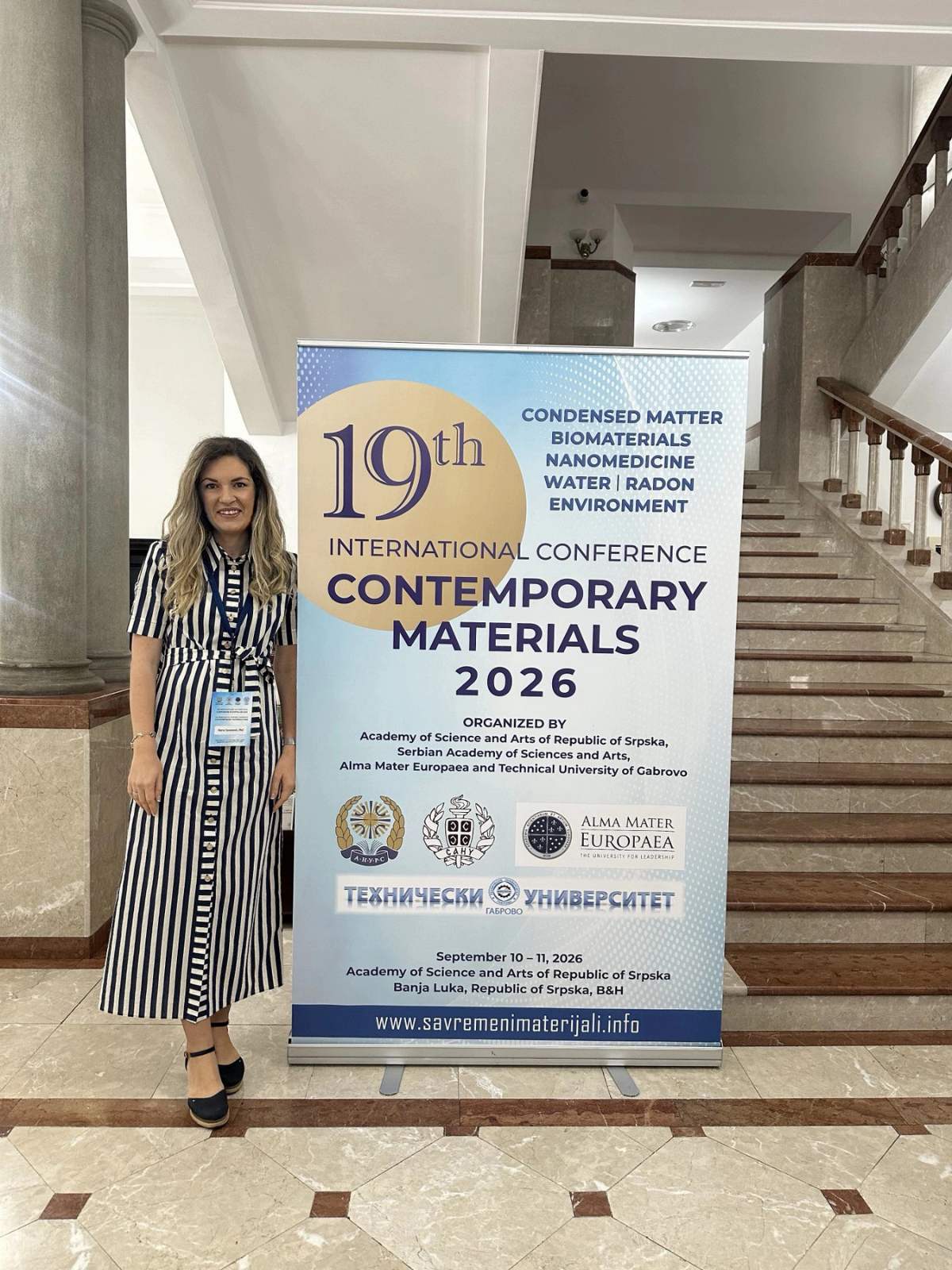
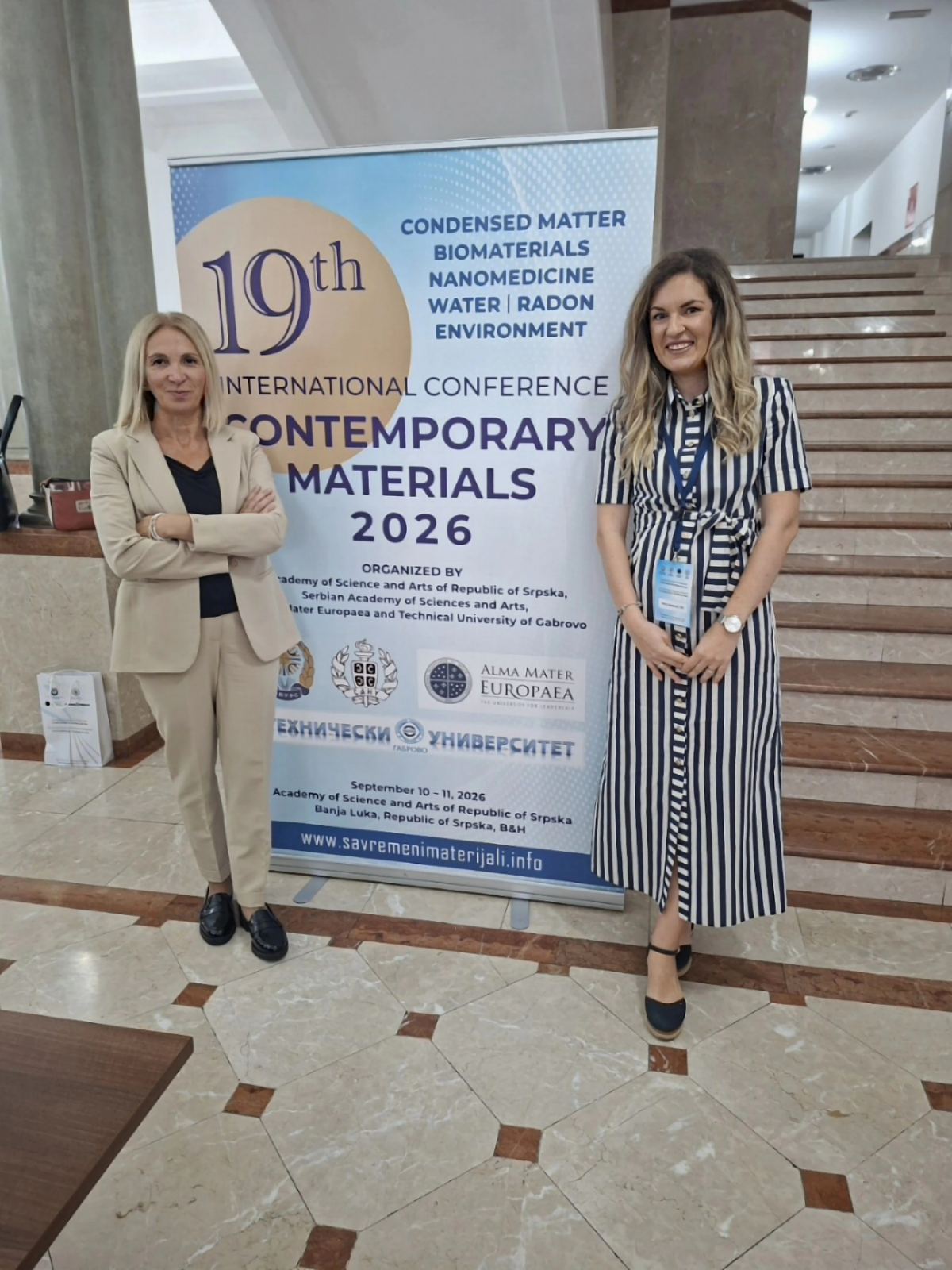
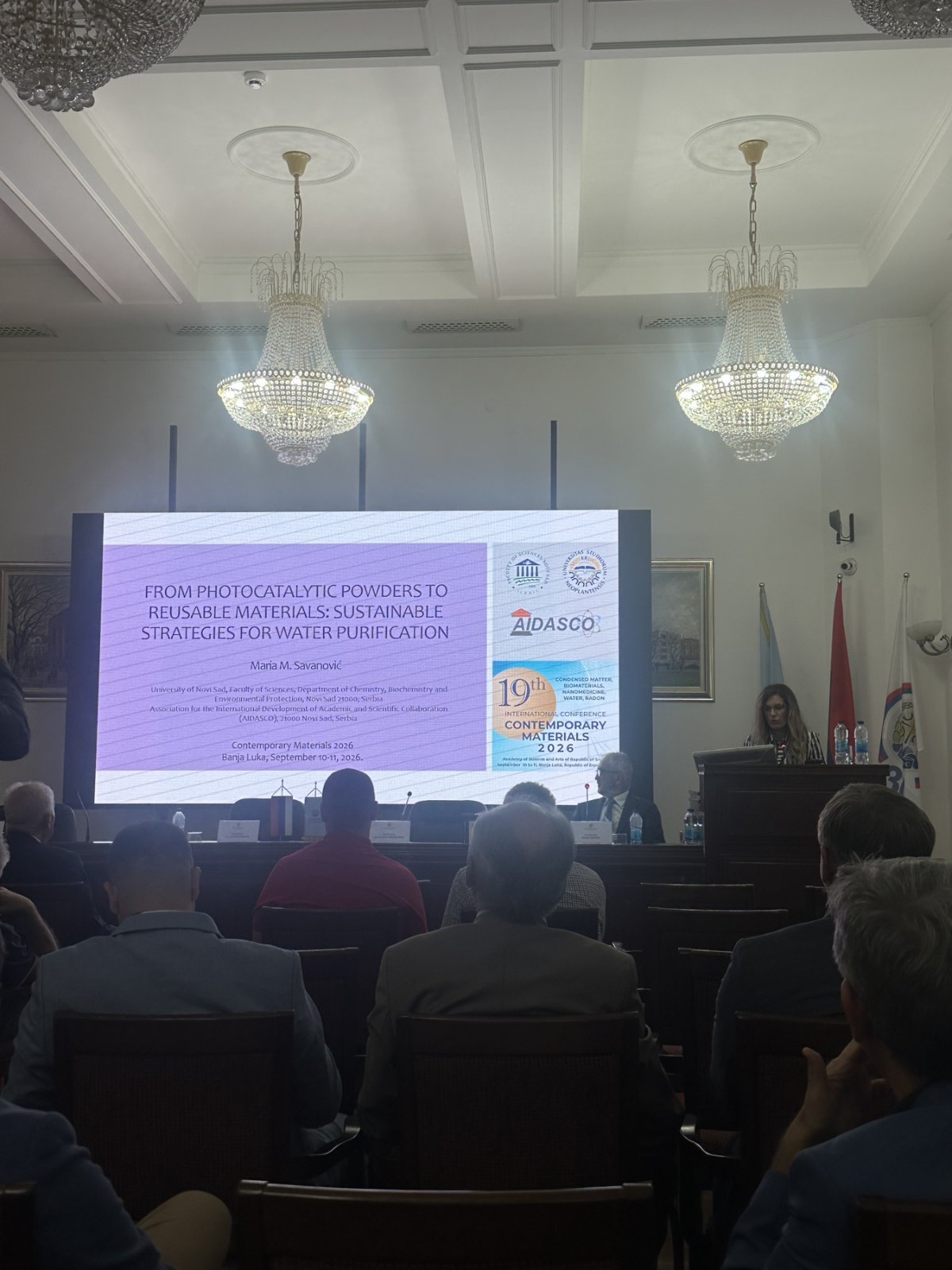
We are pleased to share that Dr. Maria M. Savanović, member of the EMOS research group, successfully participated in the 19th International Scientific Conference “Contemporary Materials 2026”, held in Banja Luka on September 10–11, 2026, where she delivered a plenary lecture entitled:
“From Photocatalytic Powders to Reusable Materials: Sustainable Strategies for Water Purification”
The conference was organized by the Academy of Sciences and Arts of the Republic of Srpska and brought together researchers working across a broad range of topics in modern materials science. The meeting was organized around four main symposia covering condensed matter and solid-state physics, biomaterials and nanomedicine, water, and environmentally sustainable materials.
Maria’s participation provided an excellent opportunity to present recent EMOS research to the broader materials-science community and to exchange ideas with researchers working on sustainable materials, environmental protection and water purification.
Check out the photo gallery
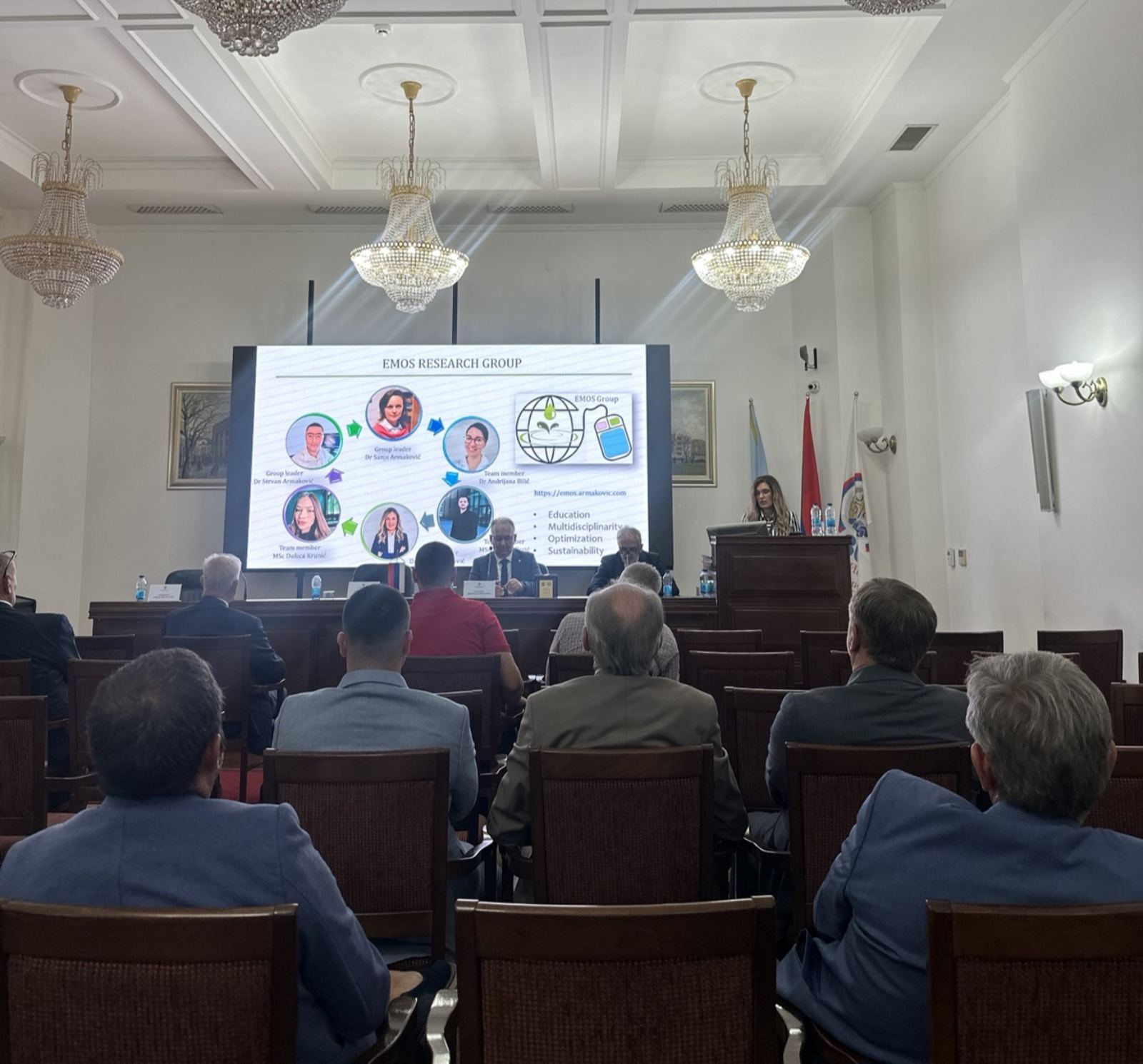
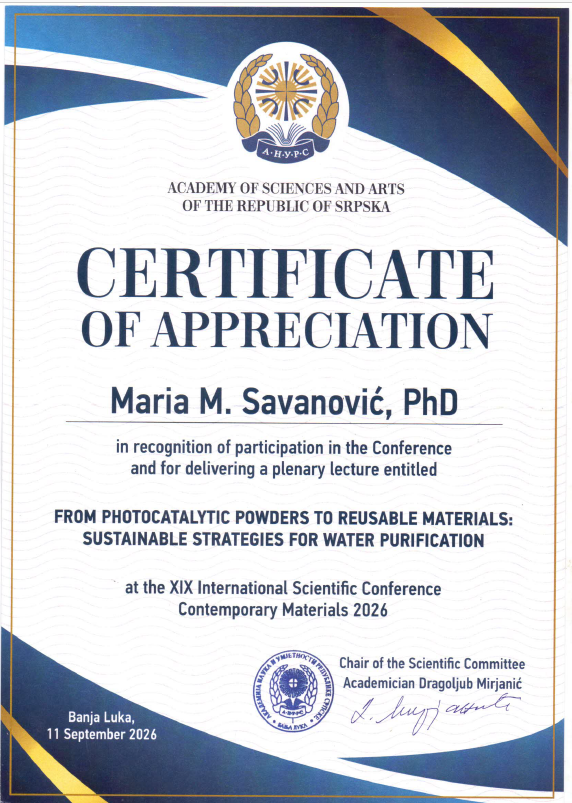
From effective photocatalysts to practical materials
Maria’s plenary lecture addressed an important research direction within the EMOS group: the development of photocatalytic materials for the removal of organic pollutants from water, with particular emphasis on approaches that combine high degradation efficiency with improved material handling, stability and reusability.
Semiconductor photocatalysts such as TiO₂ and ZnO have long attracted attention because of their ability to promote the degradation of organic contaminants under irradiation.
However, many photocatalytic systems are still applied in the form of fine powders. Although powders can provide a large active surface area and good contact with pollutants, they also introduce an important practical limitation: after treatment, the catalyst needs to be separated from the water.
This additional separation step can complicate the overall purification process, increase operating costs, and potentially create secondary contamination if photocatalyst particles remain dispersed in the treated water.
For this reason, current research increasingly focuses not only on how efficiently a photocatalyst can degrade a pollutant, but also on whether that photocatalyst can be recovered, reused, and incorporated into a practical treatment system.
Maria’s plenary lecture focused precisely on this transition.
Immobilization as a strategy for catalyst reuse
One promising approach is the immobilization of photocatalytic materials on suitable supports.
Instead of allowing photocatalyst particles to remain freely suspended in water, the active material can be incorporated into or attached to a larger structure that can be more easily handled after treatment.
Such systems may offer several advantages, including easier catalyst recovery, improved mechanical stability, reduced material loss, and the possibility of reuse over multiple treatment cycles.
At the same time, immobilization introduces its own scientific challenges. The catalyst must remain accessible to pollutants and light, while the supporting material must not significantly reduce photocatalytic activity.
Finding a suitable balance between activity, stability, recoverability and reusability therefore represents an important step toward the practical application of photocatalysis in water treatment.
Sustainable materials for water purification
During the lecture, Maria presented examples from research involving the synthesis and characterization of semiconductor-based photocatalytic materials, together with their application in the degradation of organic pollutants.
Particular attention was given to the comparison between suspended photocatalysts and supported or immobilized systems, including their advantages and limitations under environmentally relevant conditions.
Selected examples involving dye degradation illustrated how the transition from powdered catalysts toward reusable materials can influence both treatment efficiency and practical applicability.
The broader message is clear: future photocatalytic water-treatment technologies should not be evaluated only according to how rapidly they degrade a selected pollutant.
They should also be considered in terms of how easily the material can be recovered, how stable it remains during repeated use, and whether it can maintain adequate performance over several treatment cycles.
An important research direction within EMOS
Research on photocatalysis, environmental contaminants, materials modification and water purification represents an important interdisciplinary component of EMOS activities.
These studies combine materials synthesis and characterization, environmental chemistry, experimental degradation studies and computational approaches, allowing complex water-treatment systems to be examined from several complementary perspectives.
Maria’s plenary lecture at Contemporary Materials 2026 provided an opportunity to present this work to a broader materials-science community and to highlight the importance of moving from highly active laboratory materials toward systems that are increasingly realistic from the standpoint of reuse and application.
The topic was also closely aligned with one of the major themes of this year’s conference. Contemporary Materials 2026 included a dedicated symposium on environmentally sustainable materials, covering environmentally friendly materials and their applications, biocomposites, nanomaterials for environmental protection, secondary resources and circular-economy approaches.
Looking beyond degradation efficiency
Photocatalysis remains one of the promising approaches for addressing persistent organic contaminants in water. Nevertheless, achieving high degradation efficiency represents only one part of the challenge. For photocatalytic technologies to move closer to practical implementation, materials must increasingly be designed with their entire life cycle and mode of use in mind.
The transition from powders toward stable, recoverable and reusable materials therefore represents an important direction in the development of sustainable water-purification technologies.
Maria Savanović’s plenary lecture at Contemporary Materials 2026 highlighted recent work in this area and demonstrated how immobilization strategies can contribute to the development of more practical and sustainable photocatalytic systems.
We congratulate Maria on the successful presentation of her research and her contribution to Contemporary Materials 2026.
19th International Scientific Conference “Contemporary Materials 2026”
September 10–11, 2026
Banja Luka, Bosnia and Herzegovina
More information about the conference is available on the official Contemporary Materials website.